[ Case study ]

ETC-PZL Aerospace Industries delivered the world’s most advanced M-28 aircraft simulator for OSS 41 BLSz, developed for PZL Mielec S.A. (a Lockheed Martin company). The system supports both military and civilian training requirements, providing a high-fidelity training environment for short take-off and landing (STOL) operations, multi-crew coordination, and emergency procedures characteristic of the M-28 platform.
Year of implementation: 2022.
The M-28 “Bryza” operates in demanding conditions: short and unpaved runways, variable weather, and both military and civilian mission profiles. Creating a simulator capable of reproducing this operational spectrum required:
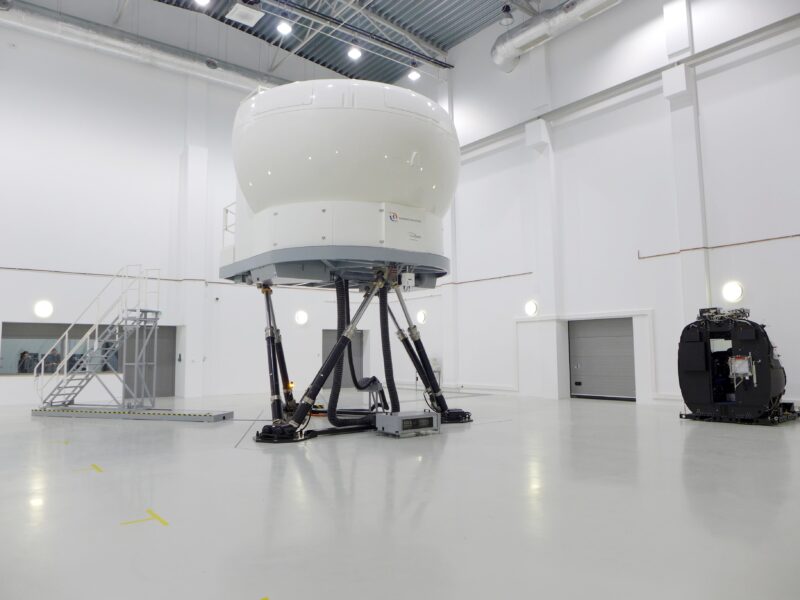
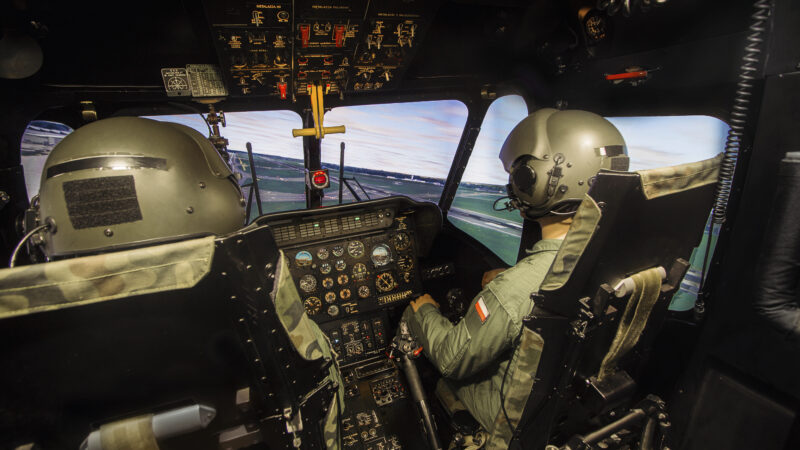
ETC-PZL delivered a high-fidelity M-28 simulator designed to meet both civil FSTD(A) Level C requirements and military training needs. The system features two fully interchangeable cockpits—one with Honeywell/Bendix King Gold Crown analog avionics and one with Rockwell Collins glass-cockpit avionics—allowing training across the full range of M-28 configurations used in Poland.
A precise replica of the M-28 cockpit was built using elements of an actual fuselage and numerous original aircraft components, supplemented by fully functional imitators of remaining systems. A six-degree-of-freedom electropneumatic motion platform reproduces the aircraft’s dynamic responses, while the wide-angle visual system (180° × 40°) enables day, night, and NVG-compatible infrared training, supporting realistic STOL operations.
Training is coordinated through dedicated operator and instructor stations that manage system power, scenario creation, environmental conditions, emergency procedures, and real-time monitoring. Integrated software simulates all major aircraft systems, allows fault injection, and provides tools for debriefing and performance analysis. The architecture supports future expansion in line with evolving mission profiles.
The project delivered a fully certified, multi-role M-28 training platform equivalent in value to a real aircraft. OSS 41 BLSz obtained a state-of-the-art simulator capable of supporting advanced multi-crew training, emergency procedures, and STOL-specific operations. Interchangeable cockpits allow trainees to practice on both major avionics configurations used by the Polish Air Force and Navy, significantly improving fleet-wide training consistency.
The high-fidelity motion system and NVG-compatible visual environment expanded training possibilities into areas that are risky, restricted, or impossible to implement during real flights. The integrated instructor-operator environment streamlined scenario creation, monitoring, and after-action review, increasing training throughput and safety.
The delivered simulator reduced dependence on real aircraft for training, lowering operating costs, airframe wear, and fuel consumption while maintaining full mission realism. OSS 41 BLSz gained a scalable platform that can be expanded with new databases, scenarios, and aircraft configurations, ensuring long-term value for both military and civilian aviation training.


The M-28 simulator demonstrates how high-fidelity, multi-role systems can support both civilian and military operators. The same architecture can be adapted to other STOL aircraft, multi-crew platforms, or mission-specific training environments requiring NVG capability, advanced motion systems, or interchangeable cockpits. Its modular design makes it suitable for air force training centers, commercial flight schools, and research institutions seeking realistic, cost-efficient alternatives to live aircraft training.