[ Case study ]

ETC-PZL Aerospace Industries delivered an advanced PZL-130 TC-II Orlik aircraft simulator for Airbus Poland S.A. and the Polish Air Force, installed at the 41st Training Aviation Base in Dęblin. The system supports the training of fourth- and fifth-year cadets of the Polish Air Force University, providing them with essential skills before transitioning to practical jet-training phases on the Leonardo M-346 Bielik. Based on proprietary technological solutions, the simulator enables tight formation flying with up to seven aircraft and offers high-fidelity mission and procedure training in a wide range of operational conditions.
Year of implementation: 2022.
The development required close cooperation with the aircraft manufacturer to obtain accurate flight-test data and continuously adapt the simulator as the aircraft evolved during introduction to service. The simulator needed to support the full syllabus of the Polish Air Force University, including cockpit procedures, advanced navigation, formation flight, radio communication, and emergency training. It also had to prepare cadets for the transition to jet aircraft by enabling training tasks that are unsafe or impossible to conduct during real flights.
ETC-PZL delivered a modular system consisting of three fully integrated components.
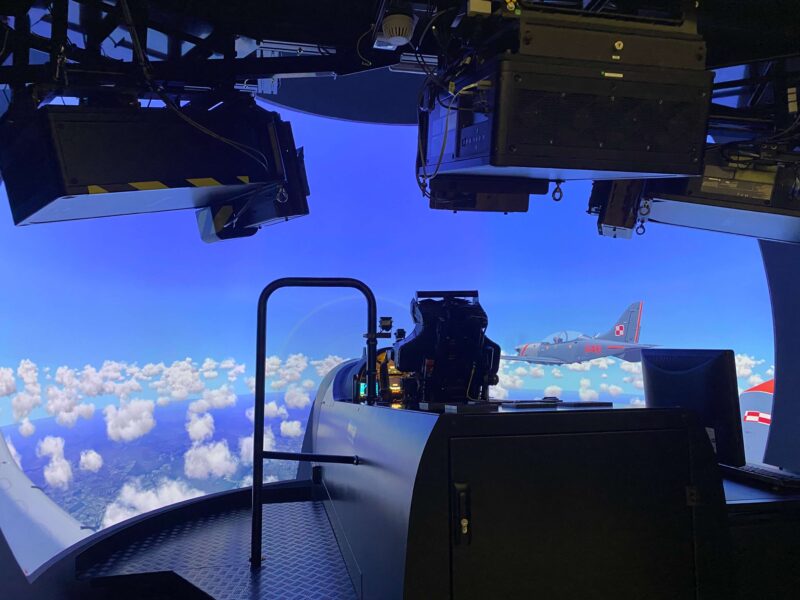
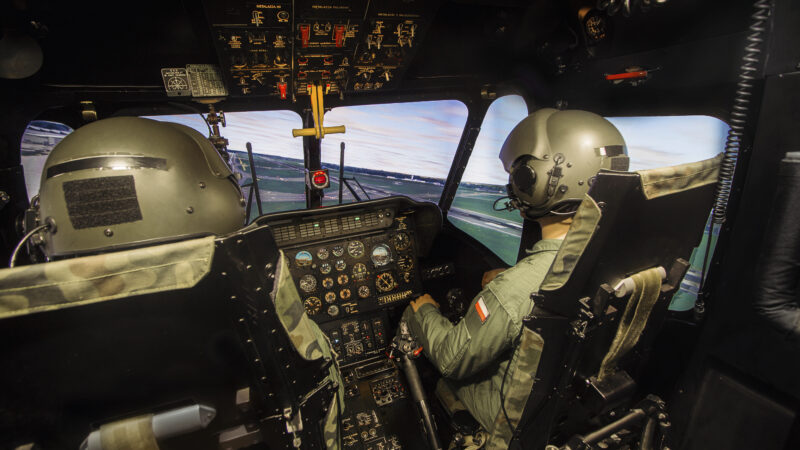
The main simulator cockpit replicates the PZL-130 TC-II interior, including complete functional avionics, instrumentation, and flight controls. Built on a static platform, it faithfully reproduces the aircraft’s acoustic, ergonomic, and operational characteristics. A spherical visualization system provides a 180° × 80° field of view through six synchronized 4K projectors, accurately depicting terrain, runways, airport infrastructure, surrounding air traffic, and diverse meteorological conditions.
The instructor-pilot station is designed as a simplified cockpit with a five-screen visualization system, enabling real-time dynamic control of a leading aircraft during formation-flight training. This allows instructors to reproduce pair and element formations, navigation challenges, and near-critical angle-of-attack exercises.
The supervising instructor station provides complete scenario management, monitoring, emergency-event triggering, and full recording and playback capabilities. Both instructor stations integrate communication tools simulating air-to-air and air-to-ground exchanges, background acoustic effects, and selective communication blocking for training purposes.
A comprehensive terrain database covers all national military air bases and civilian airports, increasing realism and mission relevance. The environment also supports simulation of other aircraft types: C-295M, F-16, M-28, M-346, and SW-4, together with realistic ground and air traffic. The software reproduces visual and instrument meteorological conditions, VFR/IFR procedures, emergencies, and a wide range of mission scenarios. The system architecture remains fully expandable for future upgrades.
With installation at the 41st Training Aviation Base in Dęblin, the simulator significantly strengthened the training infrastructure of the Polish Air Force. The project delivered a realistic, reliable, and scalable solution that enhances mission readiness across the pilot-training pipeline.


The simulator’s architecture and performance make it suitable for any training center requiring advanced formation-flight training, multi-aircraft tactical coordination, or high-fidelity procedural instruction. The platform can be adapted to other fixed-wing trainers, light-attack aircraft, or tactical mission-rehearsal environments. Its modularity and expandable software architecture ensure long-term adaptability for military aviation schools, research institutions, and air forces preparing pilots for increasingly complex operational demands.