[ Case study ]

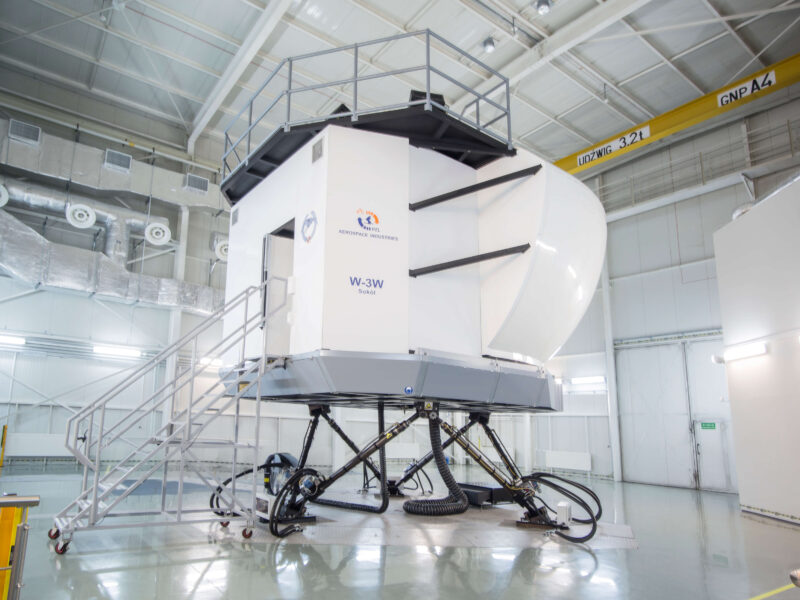
ETC-PZL developed and modernized a high-fidelity flight simulator for W-3W Sokół helicopter crew training for the Polish Armed Forces. The simulator was originally designed and built between 1997 and 2001 and has remained in continuous operational use since 2001, supported by long-term service and modernization provided by ETC-PZL.
W-3 Sokół helicopters are widely used in Poland for transport, troop insertion, search and rescue (SAR), medical evacuation (MEDEVAC), disaster response, and military support missions, including operations conducted at night and in degraded visibility. The simulator reflects these operational roles, enabling realistic training for missions that are costly, complex, or too risky to execute in live flight.
Year of implementation: in service since 2001; first modernization 2002–2003; major modernization completed in 2019.
The Polish Armed Forces required a simulator capable of supporting the full operational spectrum of W-3 Sokół missions, from basic piloting and navigation to tactical tasks, emergency procedures, and cooperation with ground forces.
At the time of initial development, no comparable solution existed on the market. ETC-PZL was therefore tasked with designing a simulator from the ground up, using specialized, proprietary technologies while faithfully reproducing the cockpit and flight characteristics of the W-3WA helicopter (VIII production series, aircraft No. 0810).
After years of successful operational use, including a first modernization in 2002–2003, which introduced simulated night flights with NVG and simulated weapon employment, the challenge evolved into maintaining operational readiness. Rather than replacing a proven system, the customer required a deep modernization that would align the simulator with contemporary training standards while preserving continuity and accumulated training value.
ETC-PZL delivered and modernized a fully immersive helicopter crew training environment built around a closed cockpit faithfully replicating the W-3WA configuration, combined with a wide field-of-view visual system and a 6 DoF motion platform.
The simulator supports comprehensive training for W-3 Sokół crews across missions typical for Polish military and government operations, including transport, SAR, MEDEVAC, troop deployment, navigation flights (VFR and IFR), emergency handling, and tactical scenarios. These missions can be practiced repeatedly under controlled conditions, including at night and in reduced visibility.
The 2019 modernization significantly expanded training capability. It included adaptation of the visual system and cockpit for the use of real night-vision goggles (NVG), deployment of a new high-detail terrain database covering Polish military air bases and civilian airports, and the addition of a troop cooperation and landing guidance station enabling joint training of helicopter crews and airborne or ground personnel during landings at unprepared or random sites.
Together, these upgrades ensured compliance with FSTD(H) Level B (with exclusions) and extended the simulator’s operational relevance for modern helicopter training.
The Polish Armed Forces retained a proven and trusted training asset, extending its operational life through modernization rather than replacement. The upgraded simulator now supports NVG operations, complex mission rehearsal, and coordinated crew–troop exercises.
The system enables repeatable, high-risk mission training without aircraft wear, fuel consumption, or safety exposure. It continues to play a key role in preparing W-3 Sokół crews for real operational tasks while maintaining continuity with 20+ years of accumulated training experience.


The “Klaudia” program demonstrates how long-life, proprietary simulation platforms can evolve alongside operational needs. Through targeted modernization, legacy simulators can remain fully relevant for contemporary missions such as SAR, MEDEVAC, night operations, and joint crew–ground training.
This approach can be replicated for other helicopter types and training centers seeking high realism, long-term sustainability, and mission adaptability without the cost and disruption of complete system replacement.